📑 Table of Contents
- 1. Quick Comparison: All Four Platforms
- 2. Why This Decision Costs More Than You Think
- 3. Kit (ConvertKit): Best for Course Creators
- 4. Beehiiv: Best for Newsletter-First Creators
- 5. MailerLite: No Longer the Budget King
- 6. Systeme.io: Best All-in-One
- 7. Pricing Math at 1K / 5K / 10K Subscribers
- 8. Deliverability: What Nobody Tells You
- 9. Micro-Case Study: The Migration
- 10. Objection Handling
- 11. The Decision Framework
- 12. Migration Checklist
- 13. Frequently Asked Questions
- 14. Bottom Line
The rest of this guide is the math behind those four sentences.
Quick Comparison: All Four Platforms Side-by-Side
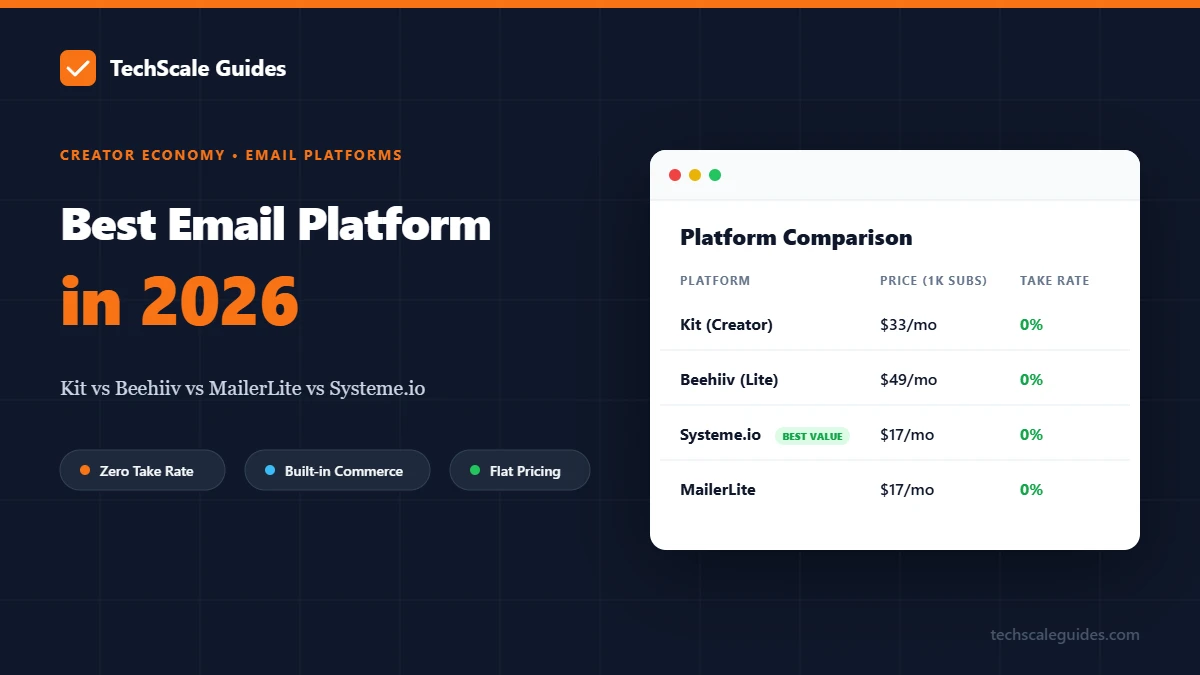
| Feature | Kit | Beehiiv | MailerLite | Systeme.io |
|---|---|---|---|---|
| Free tier | 10,000 subs (newsletter only) | 2,500 subs | 250 subs | 2,000 contacts |
| Price at 1K subs | $33/mo (annual) | $49/mo (Lite) | ~$17/mo (Comfort) | $17/mo flat |
| Price at 5K subs | ~$74/mo (annual) | ~$95/mo (Lite) | ~$44/mo (annual)* | $17/mo flat |
| Price at 10K subs | ~$116/mo (annual) | ~$119/mo (Lite) | ~$80/mo (annual) | $47/mo (Webinar) |
| Digital product delivery | ✅ Built-in | ❌ (needs Stripe/Gumroad) | ⚠️ Basic | ✅ Built-in |
| Landing pages | ✅ | ✅ | ✅ | ✅ |
| Course hosting | ❌ | ❌ | ❌ | ✅ |
| Recommendation network | ✅ (Free + Paid) | ✅ (Free + Paid) | ❌ | ⚠️ Basic |
| Automation depth | ⭐⭐⭐⭐⭐ | ⭐⭐⭐ | ⭐⭐⭐ | ⭐⭐⭐ |
| Best for | Course creators | Newsletter writers | Budget beginners | All-in-one solo creators |
(Pricing verified Oct 2026. All figures reflect annual billing equivalents; verify live pricing before committing. *MailerLite 5K reflects EUR pricing; USD may vary slightly).
Why This Decision Costs More Than You Think
Most "best email platform" articles compare feature lists. That's the wrong lens.
Here's the thing nobody tells you: the platform you pick at 500 subscribers is rarely the platform you'll be on at 5,000. Pricing models diverge wildly at scale, and a cheap starting point often becomes an expensive bottleneck later.
Take two hypothetical creators. Both start at 500 subs. By month 18, Creator A is at 8,000 subs on Kit. Creator B is at 8,000 subs on Beehiiv. Because their pricing scales differently, the annual cost difference can easily hit hundreds of dollars — enough to cover your domain, hosting, and a designer for your landing pages.
But price isn't the whole story. Creator A's Kit account has years of complex tagging and automations built up. Migrating to save money would cost a weekend of re-building those sequences and a real risk of broken automations during a launch.
Focus on which pricing curve matches your growth plan, not just which platform is cheapest today.
Kit (ConvertKit): Best for Course Creators Who Sell
Kit rebranded from ConvertKit in 2024, but the product is the same: the most creator-focused email platform on the market, built around tagging, sequences, and digital product delivery.
What Kit Gets Right
Tagging is the core primitive. Not lists, but tags. This sounds pedantic until you run a launch. With tags, a subscriber can be "interested in Course A" AND "purchased Course B" AND "clicked pricing page 3 times." You can trigger automations on any combination.
Built-in digital product delivery. You can sell an ebook, a mini-course, or a paid newsletter directly through Kit's checkout. For creators selling $27-$97 products, this saves setup time vs. using a separate platform like Gumroad. Kit Commerce charges a total of 3.5% + $0.30 per transaction, which is inclusive of standard card processing — there are no additional hidden fees or separate Stripe charges to worry about. (Source: Kit Help Center)
The Recommendations engine. Kit's cross-promotion feature lets you recommend other creators' newsletters at signup. It's a free growth channel, and the platform supports Paid Recommendations on paid plans, giving you a direct way to monetize your list. (Kit Recommendations, 2026)
What Kit Gets Wrong
No course hosting. Kit sells digital products but doesn't host structured courses with lessons and drip content. If your product is a 12-module course, you still need Teachable, Thinkific, or Systeme.io.
Email editor is fine, not great. Kit's drag-and-drop editor is functional but feels dated compared to Beehiiv's. If you send visually rich emails, you'll fight the editor more than you'd like.
Dedicated IPs cost extra. If you need a dedicated IP for high-volume sending, Kit charges a $250/mo add-on with a 150,000 messages/week minimum. It is not included in the standard Pro plan. (Source: Kit Help)
Who Kit Is For
- Course creators selling $27-$497 digital products
- Coaches running launches with complex tagging needs
- Anyone whose email list is the primary revenue driver
Who Kit Is NOT For
- Newsletter writers who want a pure ad-monetization model (use Beehiiv)
- Beginners who haven't validated a product yet (start with Systeme.io free)
- Creators who need course hosting included (use Systeme.io)
Pricing (verified Oct 2026): Free up to 10,000 subscribers (newsletter only, limited to 1 basic visual automation/sequence). Creator plan is $33/mo at 1,000 subs (billed annually, saves $72/yr). Pro plan is currently $50/mo for the first year (promo, offer ends Nov 7, 2026) at 1,000 subs. [Source: kit.com/pricing]
Beehiiv: Best for Newsletter-First Creators
Beehiiv launched in 2021 as a "newsletter operating system" and has become the default choice for writers who treat email as a media product.
What Beehiiv Gets Right
Recommendations and network monetization. Beehiiv's Recommendations network connects you with relevant publishers to cross-promote. Free recommendations are available on all plans, while Paid Recommendations (available on Lite and Pro plans) let you earn money by recommending paid products. (Beehiiv Recommendations, 2026)
The editor is genuinely good. Beehiiv's email editor is the best in the category — clean, fast, and built for long-form writing. If you write 1,500-word newsletters, this matters.
Growth analytics are excellent. Open rates, click maps, subscriber cohorts, churn analysis — Beehiiv's dashboard is closer to a media analytics tool than an email marketing tool.
What Beehiiv Gets Wrong
No digital product delivery. Beehiiv doesn't sell ebooks, courses, or downloads natively. You need Stripe + a separate product platform. This is fine if your monetization is ads + paid subscriptions, painful if you sell courses.
Automation is shallow. Beehiiv's automations cover basic sequences but lack the tagging depth of Kit. If you run complex launches with conditional branching, you'll hit limits fast.
Pricing gets expensive at scale. At 10,000 subscribers, Beehiiv's Lite plan runs ~$119/mo (annual), which is significantly higher than Kit at the same tier. You're paying for the network and analytics, not just email sending.
Who Beehiiv Is For
- Newsletter writers who want network-driven monetization
- Media-style creators building a publication
- Anyone whose growth strategy is recommendations, not funnels
Who Beehiiv Is NOT For
- Course creators who sell products (use Kit or Systeme.io)
- Creators under 1,000 subs (you're paying premium prices for network features you can't fully leverage yet)
- Budget-conscious beginners (use Systeme.io)
Pricing (verified Oct 2026): Launch plan free up to 2,500 subs. Lite plan is $49/mo at 1,000 subs (billed annually). Pro plan is $95/mo at 1,000 subs (billed annually). [Source: beehiiv.com/pricing]
👉 Deep dive: For a full Beehiiv vs Substack comparison, see our Beehiiv vs Substack guide.
MailerLite: No Longer the Budget King
MailerLite used to be the undisputed budget champion, but 2026 pricing changes altered the math.
The new reality: As of June 2026, MailerLite cut its free tier to 250 subscribers and 2,500 emails/month. The old "Growing Business" plan was replaced by Comfort and Power tiers. At 1,000 subscribers, the Comfort plan runs roughly $17/mo (annual) — still cheaper than Kit or Beehiiv, but it scales up fast. By 5,000 subs, you're paying ~$44/mo (EUR pricing; USD may vary slightly).
What you give up: Automation is basic, there's no recommendation network, and the editor is functional but not delightful.
Who it's for: Creators in the earliest stage (under 500 subs) who need a simple, cheap tool to send basic broadcasts, and who don't need the automation depth of Kit or the free tier of Systeme.io.
Pricing (verified Oct 2026): Free up to 250 active subscribers / 2,500 emails per month. Comfort plan ~$17/mo at 1,000 subscribers (annual). [Source: mailerlite.com/pricing]
Systeme.io: Best All-in-One for Solo Creators
Systeme.io bundles email marketing, sales funnels, course hosting, and affiliate management into one platform — for a flat $17/mo at the Startup tier.
Why it's different: Most platforms charge by subscriber count. Systeme.io charges by feature tier. The Startup plan supports up to 5,000 contacts for $17/mo. If you cross 5,000 contacts, you upgrade to the Webinar plan at $47/mo (which covers up to 10,000 contacts). Even at 10,000 subscribers, $47/mo is significantly cheaper than Kit or Beehiiv.
What you give up: The email editor is the weakest of the four. Automation is capable but the UI is clunky. Deliverability on shared IPs is acceptable but not premium. You're trading polish for price and consolidation.
Who it's for: Solo creators who want one login for everything — email, funnels, courses, affiliate program — and are willing to tolerate a rougher UX to save money.
👉 Full comparison: See our Systeme.io vs Kajabi vs ThriveCart guide for the checkout-layer angle.
Pricing (verified Oct 2026): Free up to 2,000 contacts. Startup $17/mo (5,000 contacts), Webinar $47/mo (10,000 contacts), Unlimited $97/mo. [Source: systeme.io/pricing]
Pricing Math at 1,000 / 5,000 / 10,000 Subscribers
Here's the same data as the comparison table, but with annual cost so you can see the real delta:
| Subscribers | Kit (annual) | Beehiiv (annual) | MailerLite (annual) | Systeme.io (annual) |
|---|---|---|---|---|
| 1,000 | ~$396/yr ($33/mo) | ~$588/yr ($49/mo) | ~$205/yr ($17/mo) | $204/yr ($17/mo) |
| 5,000 | ~$890/yr ($74/mo) | ~$1,140/yr ($95/mo) | ~$529/yr ($44/mo)* | $204/yr ($17/mo) |
| 10,000 | ~$1,392/yr ($116/mo) | ~$1,428/yr ($119/mo) | ~$961/yr ($80.10/mo) | $564/yr ($47/mo) |
(All prices reflect annual billing equivalents. *MailerLite 5K reflects EUR pricing; USD may vary slightly).
The break-even insight: Systeme.io is the cheapest at 5K and 10K subs because its pricing caps out by tier, not by subscriber count. At 1K subs, MailerLite and Systeme.io are tied for the cheapest entry point, but MailerLite scales up significantly faster as your list grows.
The hidden cost: Cheap email platforms often mean shared IPs. If your sender reputation gets dinged by other senders on the same IP, your open rates can drop significantly. Premium platforms give you better IP hygiene. At 10K+ subs, this can cost more in lost revenue than you save in subscription fees.
Deliverability: What Nobody Tells You
The docs say: "All platforms maintain 99%+ deliverability."
In practice: Deliverability is 40% platform, 60% you — your domain warm-up, your list hygiene, your send frequency, and your engagement rates.
Three things that matter more than your platform choice:
- Dedicated IP (or high-quality shared IP). Below 50K sends/month, shared IPs are usually fine on premium platforms. Above that, ask your platform whether you're on a dedicated IP. (Beehiiv offers dedicated IPs on their Enterprise plan only; Kit charges $250/mo as an add-on for theirs).
- Domain authentication (SPF, DKIM, DMARC). Every platform supports this. Many creators never set it up. Do it on day one — it takes 20 minutes and is the single highest-ROI deliverability action you can take.
- List hygiene. If a large chunk of your list hasn't opened an email in 6 months, stop emailing them. Keeping dead subscribers on your list will tank your sender reputation regardless of platform.
Micro-Case Study: The Migration That Almost Went Wrong
The Constraint: A course creator with a few thousand subscribers was paying for a premium platform but wanted to cut costs. She decided to migrate to a cheaper alternative.
The Failed Approach: She exported her list as a CSV and imported it into the new platform. Within two weeks, her open rates plummeted, and her launch sequence (6 emails over 4 days) fired but failed to convert. Revenue dropped sharply compared to previous launches.
The Implementation: She re-imported the list, but this time:
- Segmented by engagement (opened in last 90 days vs. not)
- Rebuilt her core automations from scratch (tagging logic doesn't transfer 1:1 between platforms)
- Ran a re-engagement campaign to the unengaged segment
- Waited 4 weeks before re-launching
The Quantified Result: Open rates recovered substantially, and launch revenue got back to roughly previous levels. She stayed on the cheaper platform and now saves money, but it took weeks of cleanup to get there.
The Caveat: If she'd been at 10,000+ subs or running monthly launches, the transition risk would not have been worth it. Below 5K subs and launching quarterly, the math works. Above 10K, stay where you are and negotiate a discount instead.
Objection Handling: What You're Probably Thinking
You might be thinking: "I can just use Gmail + a free tool for now."
Fair point — until you hit 500 subscribers. Gmail's 500-recipient daily limit (Source: Google Support) and zero automation kill you at scale. Use Systeme.io's free tier (2,000 contacts) instead. It costs $0 and gives you a real automation engine and course hosting.
You might be thinking: "Switching platforms is too painful."
It is — for the first two weeks. But if you're paying $99/mo for features you don't use, that's a significant annual cost you could redirect into paid acquisition. If you're above 10,000 subs, though, the risk often outweighs the savings.
You might be thinking: "Aren't they all the same?"
No. Kit's tagging, Beehiiv's recommendations network, and Systeme.io's flat pricing are structurally different products. Picking wrong means either overpaying or missing revenue.
The Decision Framework (By Revenue Stage)
Use this to pick — no more analysis paralysis.
- Stage 1 — Pre-revenue, under 500 subs:
→ Systeme.io free tier. Validate your idea before paying for anything. - Stage 2 — First product launched, 500-2,000 subs:
→ Kit Creator plan if you sell digital products. Systeme.io if you're still validating and want all-in-one. - Stage 3 — $2K-$10K MRR, 2,000-5,000 subs:
→ Kit if your revenue is course/product-driven. Beehiiv if your revenue is newsletter/sponsorship-driven. Systeme.io if you want one login and flat pricing. - Stage 4 — $10K+ MRR, 5,000+ subs:
→ Stay where you are unless the math is overwhelming. Migration cost exceeds savings at this scale. Optimize your current platform instead.
Migration Checklist (If You Decide to Switch)
If you're moving platforms, do these in order:
- Export your list with engagement data (last open, last click, tags). A raw CSV without engagement data is useless.
- Set up domain authentication on the new platform before importing anything.
- Import only engaged subscribers first (opened in last 90 days). Wait 2 weeks before importing the rest.
- Rebuild your top 3 automations manually. Do not trust CSV imports to preserve tagging logic.
- Run a re-engagement campaign to the cold segment before re-launching to the full list.
- Send from the new platform for 30 days before canceling the old one. You need a safety net if deliverability tanks.
For step 4 — rebuilding automations — the trade-off is real. You can spend a weekend doing it yourself, or hire someone who's done 50 of these migrations. If your launch is within 60 days, hiring is the lower-risk option. A Fiverr email migration specialist can handle this setup typically within a few days — a small cost compared to one botched launch.
Frequently Asked Questions
1. Is Kit the same as ConvertKit?
Yes. ConvertKit rebranded to "Kit" in 2024. The product, pricing, and features are identical. Documentation still uses both names in places.
2. Which platform has the best free tier?
Systeme.io offers the most practical free tier (2,000 contacts) because it includes automations and course hosting. Kit offers up to 10,000 subscribers but limits you to 1 basic automation and no course hosting.
3. Can I switch platforms without losing subscribers?
Yes, but you'll lose engagement data (last-open dates, click history) unless you export it. Most platforms export subscriber data but not behavioral history. Plan for a 4-6 week ramp to recover open rates.
4. Is Beehiiv worth it under 1,000 subscribers?
Usually not. The paid network features and Ad Network have specific thresholds, so you're paying premium prices for features you can't use yet. Start on Systeme.io free, migrate to Beehiiv when you hit 1,000.
5. Do I need a separate platform for courses?
Depends. Kit sells digital products (ebooks, mini-courses) but not structured courses. If your product is a 12-module course, you need Teachable, Thinkific, or Systeme.io in addition to email. Systeme.io bundles both.
6. What about Substack?
Substack is a publishing platform, not an email marketing platform. It's great for paid newsletter monetization but lacks automation and tagging. For a full comparison, see our Beehiiv vs Substack guide.
7. Can I use two platforms at once?
Yes, but don't. Running two email lists splits your audience and doubles your deliverability risk. Pick one, migrate fully, cancel the other.
8. How much should I budget for email at 5,000 subscribers?
At 5,000 subscribers, annual costs vary widely. Systeme.io caps at $204/yr (Startup tier). MailerLite runs ~$529/yr. Kit sits at ~$890/yr, while Beehiiv is the most expensive at ~$1,140/yr.
Bottom Line
Your email list is the only asset the algorithm can't take away. The platform you choose should match your monetization model — not the other way around.
- Selling courses or digital products? Kit. The tagging and product delivery are worth the premium.
- Running a newsletter you want to monetize with paid recommendations? Beehiiv. The network is the whole reason to be there.
- Want everything in one login at flat pricing? Systeme.io. Rough UX, unbeatable price.
- Just need basic email under 500 subs? MailerLite. Cheapest entry point, but watch the limits.
If you're switching platforms and don't want to rebuild your automations from scratch, an Upwork automation specialist can handle the technical setup. They can also build your launch sequence on the new platform, saving you from one botched launch.
Price is what you pay. Cost is what you eat. Choose the platform whose pricing curve matches your next 12 months, not your last 12.