📑 Table of Contents
🎯 Key Takeaways — What You'll Learn
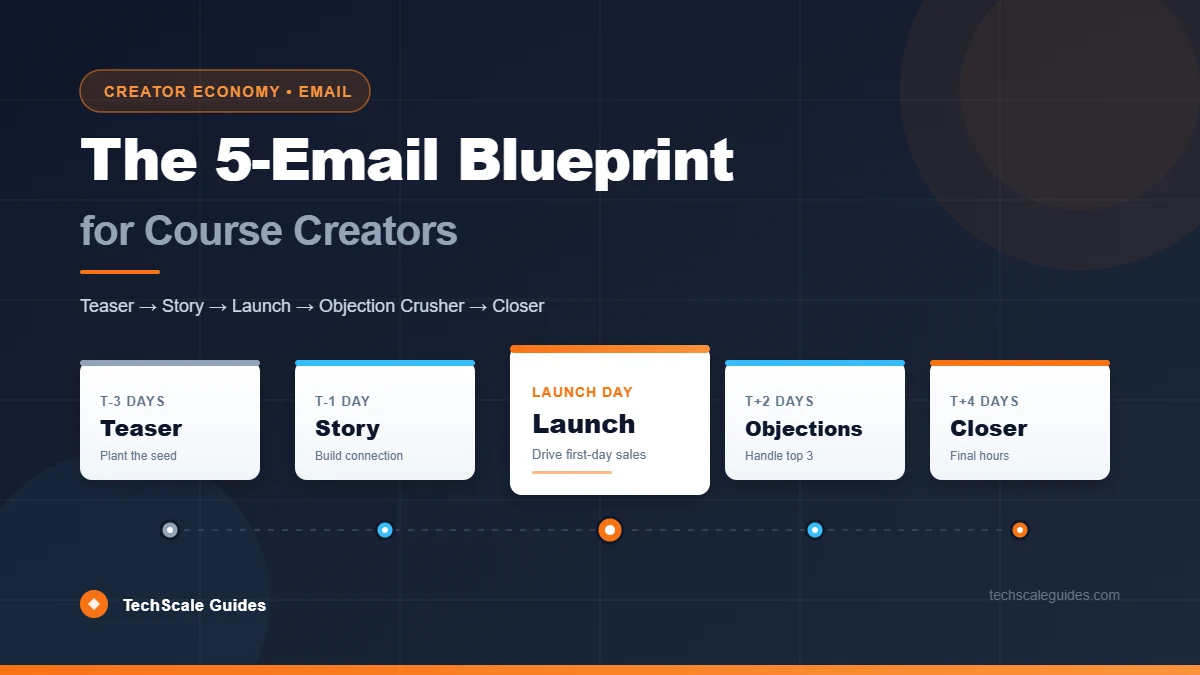
- 5 emails, 7 days — Teaser → Story → Launch → Objection Crusher → Closer
- Copyable templates — Fill-in-the-blank emails you can ship today
- Platform comparison — Systeme.io, MailerLite, Kit, Beehiiv with verified pricing
- 5 metrics to track — Open, CTR, reply, conversion, unsubscribe
- Why warm lists convert — Trust buildup before the pitch
- Post-launch continuity — Day 7 + Day 14 emails that keep the list warm
Why Pre-Launch Matters
Here's the deal. You spent 3 months building the course. You email your list on launch day. You get 12 sales from 2,000 subscribers — a 0.6% conversion rate.
Sound familiar?
The problem isn't your product. It's that your audience went from "who is this person" to "buy now" in a single email. Trust requires buildup. A cold launch email doesn't create trust — it creates friction.
Pre-launch sequences solve this. By emailing 5 times over a week, you shift the relationship from stranger → acquaintance → prospect. When launch day arrives, your list has already heard your voice, your story, and your reasoning.
Why warm lists convert better: Warm subscribers engage with multiple emails before buying. Cold subscribers see one pitch, feel pressured, and either buy immediately or bounce. Across creator communities we've studied, warm pre-launch sequences consistently produce a meaningful lift over cold-day pitches — though the exact multiple depends heavily on list quality and existing audience relationship.
The secondary benefit is list health. A 5-email sequence gives subscribers multiple chances to engage or unsubscribe. Those who stay are your buyers. Those who leave were never going to convert anyway — better to know now than after launch week.
👉 If you haven't built your list yet, start there: see our Lead Magnet Guide for Course Creators.
This article is part of our complete Creator Economy Growth Blueprint — read the pillar for the full 11-system framework.
The 5-Email Framework
Here's the framework. Each email has one job. None overlaps.
Email 1 — The Teaser (T-3 days)
Purpose: Plant the seed. Build curiosity without revealing the product.
Subject line formula: "Something's been cooking..." or "I've been quiet for a reason"
Body structure:
- Context (2 sentences): Reference recent silence or ongoing work.
- Hint (2 sentences): What you've been building, without details.
- Soft CTA (1 sentence): "Keep an eye on your inbox this week."
What NOT to do: Don't reveal the product, price, or launch date yet. The teaser's job is anticipation.
Mini example:
"Hey — I've been quiet lately. Not vacation. I've been building something I've wanted to make for two years. It's almost ready. Wednesday, I'll tell you more."
Email 2 — The Story (T-1 day)
Purpose: Build emotional connection. Give your audience a reason to care before the pitch.
Subject line formula: "Why I built this" or "The 3 a.m. thought that wouldn't leave me alone"
Body structure:
- Origin story (3-4 sentences): The moment you realized this needed to exist.
- Problem validation (2 sentences): Name the specific pain your audience faces.
- Engagement CTA (1 sentence): "Hit reply — what's the #1 thing blocking your next launch?"
What NOT to do: Don't pitch yet. Reply-rate is the metric here, not click-rate.
Mini example:
"Two years ago I launched my first course to 800 subscribers. 3 sales. I cried. Not because of the money — because I knew the content was good and I couldn't figure out what was wrong. Here's what I learned the hard way..."
Email 3 — The Launch (T-0)
Purpose: Announce. Drive first-day sales. Capture urgency.
Subject line formula: "It's live — [Product Name]" or "[Product Name] is open (first 48h bonus)"
Body structure:
- Direct announcement (1 sentence): "It's live." Don't be clever.
- Benefit bullets (4-5): What they walk away with.
- Early-bird incentive (1-2 sentences): "First 48 hours get [bonus]"
- CTA (1 sentence): "Get in before the bonus expires."
- PS line: Recap scarcity + link again.
What NOT to do: Don't bury the CTA below 6 paragraphs of story.
Mini example:
"It's live. [Course Name] — the framework that took my launch from 3 sales to $18K. 4 modules, 6 hours of video, all templates included. First 48 hours: bonus 1:1 onboarding call. Get in → [link]"
Email 4 — The Objection Crusher (T+2)
Purpose: Handle the top 3 objections that prevented purchase on launch day.
Subject line formula: "Still thinking about it?" or "The 3 questions I keep getting"
Body structure:
- Acknowledge (1 sentence): "I've gotten dozens of replies with the same three questions."
- Objection 1 + reframe + proof (3-4 sentences)
- Objection 2 + reframe + proof (3-4 sentences)
- Objection 3 + reframe + proof (3-4 sentences)
- CTA (1 sentence): Restate offer + link.
What NOT to do: Don't argue. Acknowledge the objection as valid, then reframe.
Mini example:
"Three questions keep showing up. (1) 'Is $297 too much?' — Only if it doesn't pay back. One repeat customer covers it. (2) 'How long to finish?' — 4 hours. Split across two weekends. (3) 'I'm a total beginner' — Perfect. Module 1 assumes zero experience."
Email 5 — The Closer (T+4, final hours)
Purpose: Last-chance urgency. Convert the fence-sitters.
Subject line formula: "Closing at midnight" or "Last call — doors close in 6 hours"
Body structure:
- Scarcity (1 sentence): What's actually ending.
- What they lose (2 sentences): Bonus expires, price increases, or waitlist starts.
- Social proof (2-3 sentences): "Over [X] creators joined this week."
- Final CTA (1 sentence): Big button, single action.
- PS line: "If you've been on the fence — this is the moment."
What NOT to do: Never fake urgency. If you said "closes at midnight," close at midnight.
Mini example:
"Doors close tonight at 11:59pm. After that, the bonus goes away and the waitlist opens for the next cohort. If you've been reading these emails and nodding — this is your moment. [Get in →]"
Post-launch (T+5+)
After Email 5, don't disappear. Two moves:
- Day 7: "Thank you" email with behind-the-scenes numbers. Builds trust for next launch.
- Day 14: Case study email from a buyer. Organic social proof.
Both keep the list warm between launches.
Copy Templates
Here are 5 fill-in-the-blank templates. Copy, edit, ship.
Template 1 — Teaser
Template 2 — Story
Template 3 — Launch
Template 4 — Objection Crusher
Template 5 — Closer
Platform Setup
Where you host the sequence matters. Three platform types:
All-in-one (recommended for beginners)
Systeme.io handles email + landing pages + checkout in one place.
- Free tier: up to 2,000 contacts (3 funnels, 1 automation rule)
- Startup plan: $17/mo (dropped from $27 in 2025). Verified at Systeme.io pricing — October 2026.
Affiliate disclosure: The Systeme.io link above is an affiliate link — we may earn a commission at no extra cost to you.
Email-only + external checkout
- MailerLite — Free up to 250 subscribers. Comfort tier is $12/mo (or $10.80/mo billed yearly) at 500 subscribers. Verified at MailerLite pricing — October 2026.
- Kit (formerly ConvertKit) — Free up to 10,000 subscribers. Creator tier is $33/mo billed yearly for 1,000 subscribers. Verified at Kit pricing — October 2026.
- Beehiiv — Free tier available. Lite plan starts at $49/mo, Pro plan at $95/mo (yearly billing). Verified at Beehiiv pricing — October 2026.
Advanced automation
n8n self-hosted (n8n 2.x — current stable 2.41.6, verified at docs.n8n.io/changelog, October 2026) connects your email platform to CRM, Slack, or custom APIs. If you're comfortable with Docker, this unlocks conditional logic (e.g., pause sequence on purchase). See our n8n workflow automation guide.
Rule of thumb
Under $10K lifetime revenue → all-in-one. Over that → email-only + n8n for automation. The extra monthly cost is worth it once revenue justifies it.
Disclosure: We are reader-supported. Some links are affiliate links — we may earn a commission at no extra cost to you.
Metrics — What "Good" Looks Like
Track 5 metrics per email:
Open rate.
GetResponse's Email Marketing Benchmarks report — based on analysis of 4.4 billion messages — found an average global open rate of 39.64%. Course launch emails often perform above general marketing benchmarks because subscribers opted in recently. Verified at GetResponse — increase email open rate — October 2026.
Click-through rate (CTR).
The same report shows an average CTR of 3.25% across all email types. Notably, triggered/automated emails — which is what your launch sequence actually is — average 5.02%. That's the number worth tracking against. Verified at GetResponse — increase email open rate — October 2026.
Reply rate.
Unique to story emails (Email 2). Even 1-2% is strong. Replies warm sender reputation + surface real objections.
Conversion rate.
Percentage of subscribers who buy. Conversion depends heavily on list quality and offer fit — track yours against your own previous launches rather than industry averages.
Unsubscribe threshold.
A small unsubscribe rate per email is normal and healthy — non-buyers self-filter before launch day. A spike during launch week often signals the copy doesn't match audience expectations.
Common Pitfalls
1. Sending only launch day.
One email ≠ sequence. Warm-up takes 5 touches minimum.
2. Fake urgency.
Promising "closes tonight" when it doesn't = trust damaged permanently.
3. Generic copy.
"Dear subscriber" reads as mass email. "Hey Sarah" reads as personal.
4. No segmentation.
Buyers get "buy now" emails they don't need. Segment: buyers → upsell; non-buyers → nurture.
5. Zero replies.
If no one replies, sender reputation suffers. Reply-prompt in Email 2 is not optional.
6. Automation without testing.
Send test emails to yourself first. Check mobile preview. Links break. Typos happen.
Frequently Asked Questions
1. How long should a pre-launch sequence be?
5 emails is the sweet spot. 3 is too few (no trust), 8+ triggers fatigue. Exception: high-ticket ($1K+) offers justify 7-10 touches.
2. When do I start?
T-3 days for Email 1. Launch day for Email 3. Final closer T+4. Total window: 7 days.
3. What if my list is small (under 500)?
Small list ≠ weak sequence. Same 5-email framework. Personal touches (reply to every response) matter more at small scale.
4. All-in-one platform vs email-only platform — which is better?
It depends on whether you already have checkout elsewhere. All-in-one handles email + landing + checkout in one place. Email-only is cheaper if you already have a separate checkout. Verify current pricing before deciding — vendor pricing changes frequently.
5. What's a good open rate for course launches?
Benchmark data varies widely by industry and list age. Track yours against your own baseline rather than an industry average — GetResponse's benchmark report (linked in Section 5) is a good reference for broad industry ranges.
6. How many times should I email about the same launch?
5-7 total across 7-10 days. More if high-ticket, fewer if low-ticket.
7. What if I get unsubscribes during the sequence?
Normal — a small rate per email is healthy. Only worry if it spikes during launch week, which usually signals copy mismatch.
8. Can I automate this with n8n?
Yes. See our n8n automation guide. Conditional triggers (pause on purchase, escalate on reply) require external automation.
Bottom Line
Three things to take away:
1. Cold launches fail by design. One email on launch day is not a strategy — it's a gamble.
2. Five emails, seven days. Teaser → Story → Launch → Objection Crusher → Closer. Each has one job.
3. Warm lists convert higher. Not 10x. Not 100x. But meaningfully — enough to justify the extra writing time.
If you'd rather skip the writing — hire an email sequence specialist on Upwork. Most deliver a tested 5-email sequence in under a week.
🚀 Ready to Launch With a Warm List?
Stop launching to an empty room. Build the 5-email pre-launch sequence this week — with copyable templates, verified platform pricing, and the metrics that matter.
Hire a Vetted Specialist →