📑 Table of Contents
- 1. The 30-Second Comparison
- 2. Beehiiv — The 0% Cut Monetization Engine
- 3. Substack — Simplicity + Native Network
- 4. Head-to-Head: 6 Dimensions That Matter
- 5. When to Choose Beehiiv
- 6. When to Choose Substack
- 7. Migrating from Substack to Beehiiv (If You Switch)
- 8. Beyond Newsletters — When You Need a Full Creator Stack
- 9. Frequently Asked Questions
- 10. Bottom Line
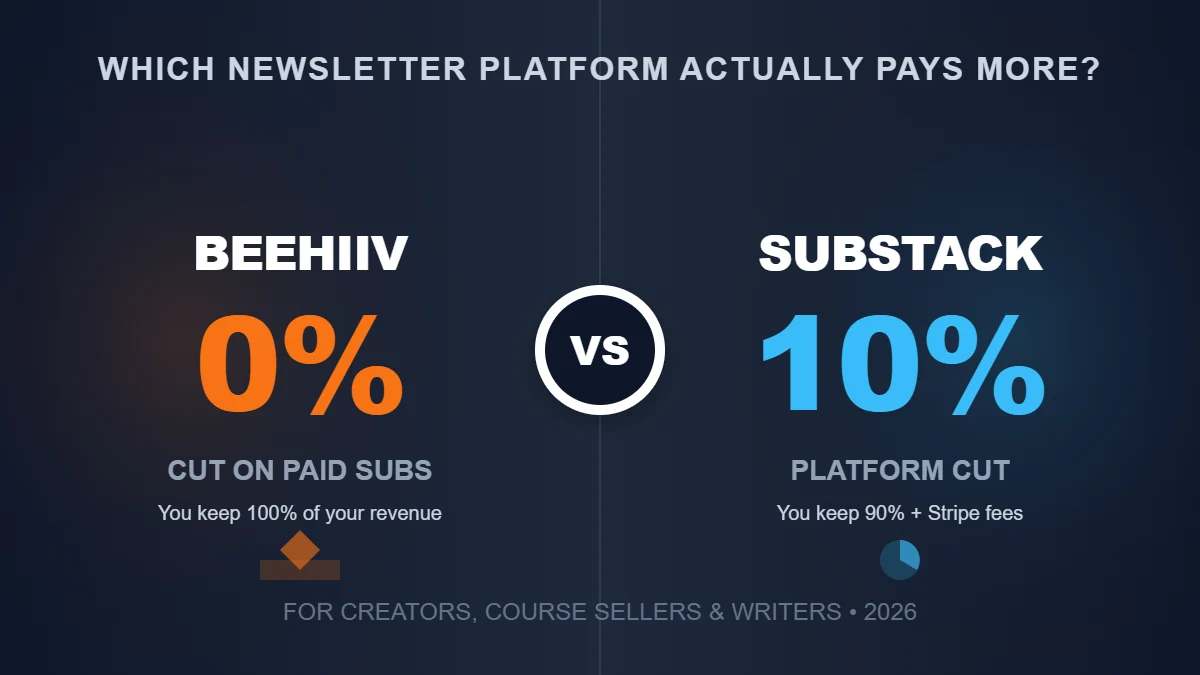
Both are free to start. Both let you write. Only one keeps 100% of your paid-subscription revenue.
Here's the 30-second version:
- Substack takes a 10% cut of your paid subscriptions, plus Stripe fees. It offers Notes, Recommendations, Boost (automated upsell/discounts), Subscriber Referrals, Native Sponsorships (eligibility-gated), and A/B testing.
- Beehiiv takes 0% of your paid subscription revenue. It offers Boosts (paid cross-recommendations), Referral Program, a native ad network, and a Community feed. You pay a flat monthly fee based on your total list size.
- If you sell courses, digital products, or memberships → Beehiiv usually wins on monetization math because you keep 100% of the revenue.
- If you only sell your writing → Substack's 10% cut is fair, and its native network (Notes) is excellent for discovery.
"Which pays more" depends on three things: your subscriber count, what you're selling, and how much you value your time on growth.
Let's run the numbers.
The 30-Second Comparison
| Dimension | Beehiiv | Substack |
|---|---|---|
| Fee on paid subs | 0% | 10% + 0.7% Billing (Stripe) |
| Free tier | Up to 2,500 subscribers (as of Oct 2026) | Unlimited subscribers |
| Paid plans | Tiered by total subs (starts at $49/mo yearly for 1k subs) | Free (10% revenue cut only) |
| Growth tools | Boosts (paid cross-recommendations), Referral Program, A/B testing | Notes, Boost (upsell optimization), Subscriber Referrals, A/B testing |
| Ad monetization | Native ad network (from Lite plan) | Native sponsorships (Bestsellers only) |
| Community layer | Beehiiv Community feed (publication-owned) | Substack Notes (network-wide) |
| Migration | Substack → Beehiiv supported | Beehiiv → Substack supported (Free subs only) |
| Best for | Creators who sell products | Writers who don't sell |
That's the surface. Here's what those lines actually mean when you're trying to make money.
Beehiiv — The 0% Cut Monetization Engine
Beehiiv was built for one thing: helping you grow an audience and monetize it without giving up a cut of your paid subscriptions.
Pricing (Tiered by List Size)
Beehiiv runs a freemium model with paid tiers. Crucially, Beehiiv prices its plans based on your total subscriber count (free + paid), not just your paid subscribers (Beehiiv pricing blog, as of Oct 2026).
Note: Beehiiv announced new pricing on Oct 1, 2026. The official blog lists the new annual-billing rates at 1,000 subscribers as Lite $49/mo and Pro $95/mo. (Some public landing pages may still display discounted promotional rates of $39.20/$76, which is 20% off, but we use the officially announced new rates for our math below to ensure accuracy).
- Free ($0) — capped at 2,500 subscribers.
- Lite ($49/mo on yearly billing) — includes paid subscriptions with a 0% take rate, ad monetization, and automations. As your list grows (e.g., 10k+), the price scales up.
- Pro ($95/mo on yearly billing) — includes advanced analytics, webhooks, remove Beehiiv branding, and priority support. Also scales by list size.
(Monthly billing is roughly 20% higher for Lite and 15% higher for Pro compared to yearly billing).
You pay for the platform based on your audience size, not for what you earn. On Beehiiv, you keep 100% of your paid subscription revenue — minus your tier fee and standard Stripe processing.
The 0% Revenue Share
This is the headline. Beehiiv takes 0% of your paid subscription revenue (Beehiiv pricing, as of Oct 2026).
Compare that to Substack's variable take (10% + 0.7% Billing fee): on a $10,000/mo paid newsletter, Substack keeps $1,070/mo in platform fees. On Beehiiv, you keep that $1,070 — you only pay your flat tier fee.
At scale, this gap is massive. If you're making $50,000/mo, Substack's 10% cut plus Stripe Billing totals $5,350/mo ($64,200/year). Beehiiv takes $0 of that.
Growth Tools
Beehiiv gives you multiple growth levers (Beehiiv features, as of Oct 2026):
- Boosts — paid recommendations. You pay another Beehiiv newsletter to recommend yours to their audience, priced per subscriber acquired.
- Referral Program — built-in subscriber referral system. You give readers rewards (premium content, merch, shoutouts) for referring new subscribers.
- A/B Testing — native testing for subject lines to optimize open rates.
For course creators, the referral program is the killer feature. You can reward referrals with free mini-courses, 1:1 calls, or discount codes on your main product — turning your newsletter list into a sales channel.
Ad Network + Community
Beehiiv has a native ad network (available starting from the Lite plan). Sponsors pay you directly for placements in your newsletter.
Beehiiv also launched a Community feed in July 2026 (Beehiiv product updates, as of Oct 2026). It allows members to post text, images, or audio, comment, and react — turning your newsletter from a one-way broadcast into a two-way social space owned by your publication.
Who It's For
Beehiiv is for creators who treat their newsletter as a funnel, not a product. If you sell courses, ebooks, templates, coaching, or memberships — Beehiiv's 0% cut and monetization stack are built around that.
If you only sell your writing, Beehiiv's flat monthly fee might feel like an unnecessary overhead.
Substack — Simplicity + Native Network
Substack built a different thing: a place where writers can get paid directly by readers, with discovery built into the platform.
The Fee Model
Substack takes a 10% cut of every paid subscription, plus payment processing fees. Specifically, the cost structure is 10% Substack fee + Stripe processing (2.9% + 30¢) + Stripe Billing fee (0.7%) for recurring subscriptions (Substack support, as of Oct 2026).
(Note: Substack's primary cost page lists the 0.7% Billing fee; some older help articles mention 0.5%, but 0.7% is the current standard).
No monthly fee — you only pay when you earn.
On the surface, that's a clean deal: no fixed cost, you only pay for what works.
The catch: the ~10.7% variable take scales with your success. A $50,000/mo newsletter pays $5,350/mo in platform/billing fees. That's $64,200/year to Substack. If your profit margins are thin, that variable cut hurts more than a flat software fee.
Notes + Community
Substack's secret weapon is Notes — a Twitter-like feed where writers share short posts and link to each other's work. It lives inside the Substack app, so discovery is native (Substack Support, as of Oct 2026).
For writers who want community built into the platform, this is huge. You don't need to build an audience on Twitter or LinkedIn first — Substack's own network does some of it for you.
Reader Network Effect + Growth Tools
Substack's Recommendations feature lets you recommend other Substacks to your readers, and they recommend you back (Substack Recommendations, as of Oct 2026). It's a mutual discovery engine.
Substack has significantly matured its growth tools:
- Subscriber Referrals: Native referral program with reward tiers (e.g., 2, 10, 25 referrals) and automated fulfillment (Substack Referrals, as of Oct 2026).
- A/B Testing: Native testing for headlines/subject lines. (Note: Requires 200+ subscribers to unlock) (Substack A/B, as of Oct 2026).
- Boost: An automated upsell/discount optimization tool (e.g., free trials, pre-cancel offers) — different from Beehiiv's paid acquisition Boosts (Substack Boost, as of Oct 2026).
Native Sponsorships
As of June 2026, Substack launched a native sponsorships program that handles matching, logistics, and payouts for writers who want to monetize through brands (Substack blog, as of Oct 2026). Note that this program is eligibility-gated, currently limited to Substack Bestsellers — which is typically defined as creators with 100+ paid subscribers (Nieman Lab, secondary source). You no longer have to sell and invoice sponsors manually if you qualify.
Who It's For
Substack is for writers who:
- Don't sell courses or products
- Want the platform to handle community + discovery
- Value simplicity over managing a dashboard of growth tools
- Accept paying a ~10.7% variable fee for "no monthly fees, we only win when you win"
If you write essays, investigative journalism, or serialized fiction — Substack is a good fit.
If you sell products, the variable fee eventually becomes the problem.
Head-to-Head: 6 Dimensions That Matter
Here's where the two platforms actually diverge. Not "which is better" — which is better for you.
1. Monetization Math
The single biggest decision factor. Run the numbers on your own subscriber base.
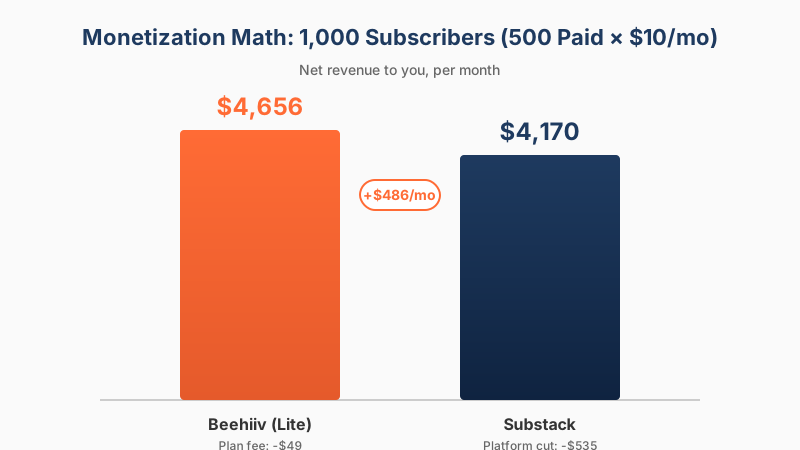
Scenario: 1,000 total subscribers, 500 of them paying $10/mo ($5,000/mo gross revenue)
| Beehiiv (Lite) | Beehiiv (Pro) | Substack | |
|---|---|---|---|
| Gross paid revenue | $5,000/mo | $5,000/mo | $5,000/mo |
| Platform fee | $49/mo | $95/mo | $535/mo (10% + 0.7%) |
| Stripe card fees* | $295/mo | $295/mo | $295/mo |
| Net to you (Monthly) | $4,656.00 | $4,610.00 | $4,170.00 |
| Net to you (Annual) | $55,872.00 | $55,320.00 | $50,040.00 |
| Difference (vs Substack) | +$5,832.00/yr | +$5,280.00/yr | — |
(Processing assumes standard Stripe card rates: 2.9% + 30¢ per transaction for 500 subs).
At this 1,000-subscriber scenario, Beehiiv saves you roughly $5,280 to $5,832 per year.
In the $10,000/mo scenario mentioned above, Substack keeps $1,070/mo in platform fees. For the $5,000/mo scenario in this table, Substack's platform fee is $535/mo. The table shows the net revenue after both platform fees and Stripe processing.
The crossover point is where your Substack variable fee equals Beehiiv's flat tier fee:
- 1,000 total subs (Lite): ~$458/mo in paid revenue.
- 1,000 total subs (Pro): ~$888/mo in paid revenue.
Below these thresholds, Substack is cheaper. Above them, Beehiiv wins and the gap widens.
2. Growth Tools
Both platforms now have strong growth tools, but they approach it differently.
- Beehiiv: Boosts (paid cross-recommendations), Referral Program (subscriber-get-subscriber rewards), A/B testing.
- Substack: Notes (social feed), Recommendations (free cross-promos), Boost (upsell optimization), Subscriber Referrals, A/B testing.
Why this matters for creators: If your newsletter is a funnel for a course or product, Beehiiv's referral program lets you reward readers with a discount code for your product — directly driving sales. Substack has referrals too, but lacks native commerce tools.
Why this matters for writers: Substack's Notes + Recommendations network is highly active and drives free, organic discovery. Beehiiv's growth tools require you to actively manage campaigns.
3. Pricing (Hidden Costs)
Beehiiv hidden costs:
- Subscriber scaling — your monthly bill increases as your total list grows, regardless of how many people actually pay you.
- Boosts budget — you pay per subscriber acquired, not per impression.
- Ad network access — requires the Lite plan or higher.
Substack hidden costs:
- ~10.7% revenue cut — 10% platform fee + 0.7% Stripe Billing fee.
- Payment processing — 2.9% + 30¢ per transaction (Stripe pricing, as of Oct 2026).
Net: Beehiiv has predictable costs (fixed monthly, scales with audience). Substack has variable costs (~10.7% + Stripe). At scale, Beehiiv's 0% cut on revenue is a massive advantage.
4. Ease of Use
Honest assessment: Substack is simpler.
Substack's editor is minimal — write, publish, done. The learning curve is near zero. If you've written a Google Doc, you can write a Substack post.
Beehiiv is more powerful but has more moving parts. The dashboard has sections for Newsletter, Boosts, Referral, Ad Network, Analytics, Automations, and Community. You won't use all of them. But the cognitive load is higher.
For first-time newsletter creators, Substack wins on day one. By month three, if you're trying to monetize products, Beehiiv's extra tools start paying off.
5. Community + Discovery
Both platforms now have a native social layer, but they serve different purposes.
Substack Notes: Functions like a Twitter feed inside Substack. You share short thoughts, link to other Substacks, get discovered by readers browsing Notes. The Substack reader app is a network-wide social network for writers.
Beehiiv Community: Launched in July 2026, it's a feed for your members to post text/images/audio and interact with each other. It builds community within your publication, rather than sending you out to a broader network.
The trade-off: Substack's community is real — but it's Substack's community. You're renting distribution from their network. Beehiiv's tools (including Community) build your standalone asset.
6. Migration Cost
If you start on one and want to switch, how hard is it?
Substack → Beehiiv: Beehiiv offers a native migration path. According to their migration page, "Paid subscriptions transfer through Stripe so billing continues uninterrupted" (Beehiiv migration docs, as of Oct 2026).
Beehiiv → Substack: Substack also offers an import path from Beehiiv. However, their official guide states that only free subscribers and free posts/previews of paid posts are migrated (Substack Help Center, as of Oct 2026). Paid subscribers require manual handling.
Rule of thumb: Moving from Substack to Beehiiv preserves your paid billing flow (with the caveat above), but moving to Substack from Beehiiv means you'll have to manually manage your paid list.
When to Choose Beehiiv
Three creator profiles where Beehiiv usually wins:
1. Course creator with an email funnel
You sell a $200-$2,000 course. Your newsletter is the top of the funnel. Beehiiv's referral program lets you reward readers with mini-courses or discounts, driving course sales directly. The 0% revenue cut means more margin on any paid newsletter tier you layer on top.
2. Digital product seller (templates, ebooks, membership)
You sell multiple products. Your newsletter is the distribution engine. Beehiiv's Boosts + referral + ad network give you three monetization layers (paid subs, ads, product sales).
3. Ad-supported newsletter creator with a large list
You have a large audience and want to monetize through sponsors. Beehiiv's native ad network handles this, and because you're not paying a 10% cut, your revenue margin is higher.
Bottom line for creators: If your newsletter is a business, Beehiiv's tools are the business infrastructure.
When to Choose Substack
Three writer profiles where Substack usually wins:
1. Serial writer who doesn't sell anything
You write essays, fiction, investigative journalism. Readers pay for the writing itself. Substack's 10% cut is fair — you're paying for the platform, community, and reader network. Beehiiv's flat monthly fee would sit as an overhead cost.
2. Writer who values community + discovery over tools
You want to be part of the writing community. You like Notes, you want other writers to discover you, you're okay with the network being platform-owned. Substack's reader app is a genuine social layer.
3. Beginner newsletter creator with a low paid conversion
You're just starting. If your total list is large but your paid subscriber count is low, Substack's variable cut on a small revenue base is much cheaper than Beehiiv's tiered monthly fees.
Bottom line for writers: If your newsletter is the product, Substack's simplicity and community are the right fit.
Migrating from Substack to Beehiiv (If You Switch)
If you start on Substack and decide Beehiiv is the better long-term fit, here's the honest picture.
Beehiiv offers a native migration path for Substack writers. The general flow:
- Export your Substack archive (posts, drafts, subscriber list).
- Import to Beehiiv via their migration process.
- Paid subscriptions transfer through Stripe.
While billing continues uninterrupted via Stripe (meaning you don't need to run a massive re-authorization campaign), the process is potentially disruptive if not managed correctly.
Mitigation for a smooth launch:
- Coordinate timing: Plan the migration during a low-activity period.
- Grant temporary access passes: Give paid subscribers a free promo code or manual access to content during the handoff window so they don't lose access.
- Communicate clearly: Announce the migration 2 weeks ahead so readers know exactly what to expect.
- Cancel Substack billing: Pause or cancel your paid subscriptions in Substack immediately after the migration to prevent double billing.
If you don't have paid subscribers yet, migration is trivial — free lists transfer cleanly.
Bottom line: Migration is doable, but it requires active management to avoid churn. Start on Substack if you're unsure, because moving to Beehiiv later is easy if you prepare.
Beyond Newsletters — When You Need a Full Creator Stack
Beehiiv vs Substack is a real question, but both are primarily newsletter and audience platforms.
It's true that Beehiiv allows you to sell digital downloads (ebooks, templates) with a 0% fee, which is a massive advantage. However, if your business requires advanced LMS features (video hosting, quizzes, certificates), complex multi-step sales funnels, or built-in affiliate management, neither platform provides that out of the box. You'll end up stitching together 3-4 separate tools (e.g., Beehiiv + Teachable + ClickFunnels).
That's where an all-in-one platform like Systeme.io changes the math. It bundles your newsletter, advanced sales funnels, full course hosting (LMS), and an affiliate program in one account, starting at $17/mo (Systeme.io pricing, as of Oct 2026).
(Disclosure: The link below is an affiliate link. We may earn a commission if you sign up.)
If you need a full creator stack without the software sprawl, try Systeme.io free. If you only need a newsletter and basic digital product sales, stick with Beehiiv or Substack.
Frequently Asked Questions
1. Is Beehiiv or Substack better for course creators?
Beehiiv, generally. The 0% revenue cut, referral program, and native digital product sales are built for creators with a monetization funnel. Substack's ~10.7% variable cut and lack of native commerce tools become limiting as your course audience grows.
2. Does Beehiiv really take 0% of paid subscription revenue?
Yes, per Beehiiv's pricing page (verify at Beehiiv pricing, as of Oct 2026 — look for "0% take rate" on the Lite plan). You pay a flat monthly fee based on your total subscriber tier and keep 100% of paid subscription revenue — minus Stripe processing (2.9% + 30¢ per domestic card transaction, verify at Stripe pricing).
3. How much does Substack take from paid subscriptions?
Substack takes a 10% platform fee, plus payment processing. Specifically: 10% Substack fee + 2.9% + 30¢ Stripe card fee + 0.7% Stripe Billing fee. Verify at Substack support (as of Oct 2026). No monthly fee — you only pay when you earn.
4. Can I migrate from Substack to Beehiiv without losing subscribers?
Yes, but it requires active management. Free subscribers transfer cleanly. For paid subscribers, billing continues via Stripe, but there can be a temporary access gap during the handoff. You must grant temporary access passes to maintain trust and pause your Substack billing to prevent double charges. Verify the current flow at Beehiiv migration docs (as of Oct 2026).
5. Which platform has better growth tools in 2026?
Both are strong. Beehiiv focuses on referral programs and paid Boosts to drive conversions. Substack focuses on its native Notes network, Recommendations, Boost, and Subscriber Referrals to drive organic discovery.
6. Is the Beehiiv free plan enough for starting out?
Only if you're under roughly 2,500 subscribers. The free tier caps at that level — above it, you need a paid plan. Verify current limits at Beehiiv pricing (as of Oct 2026).
7. What happens to my paid subscribers if I switch from Substack to Beehiiv?
They continue to be billed seamlessly via Stripe. The migration process is designed to keep your revenue flowing without requiring subscribers to manually re-enter their payment info. Just remember to pause Substack billing so they aren't charged twice, and manage the temporary Stripe handoff access gap.
8. Beehiiv vs Substack — which is better for selling digital products?
Beehiiv. The referral program can reward readers with product discounts, the 0% cut means more margin on paid tiers, and Beehiiv natively allows you to sell digital downloads (ebooks, templates) with a 0% platform fee. (Note: If you need full video course hosting/LMS, you'll need an external tool). Substack is built for selling the newsletter itself, not products adjacent to it.
Bottom Line
Three things to remember:
1. Substack is cheaper for small paid lists (~10.7% cut < monthly plan fees). But for large, highly monetized lists (e.g., $458+/mo in paid revenue on the Lite plan), Beehiiv's flat fee saves you thousands per year.
2. Creators who sell products → Beehiiv. The growth tools, 0% cut, native digital product sales, and ad network are built for you. Writers who don't sell → Substack's simplicity and community win.
3. If you need an advanced LMS or full funnel stack — neither is complete. Consider Systeme.io (starting at $17/mo) before stacking 3-4 tools.
The right answer depends on what you're selling. If it's just your writing, Substack. If it's a creator business, Beehiiv. If it's a full LMS stack, look beyond both.
Need help setting up Beehiiv? A Beehiiv setup specialist on Fiverr can migrate your list, configure referrals, and connect Stripe in a few days — at a fixed-price package that saves you the manual work.
Need help with a complex migration? For large subscriber bases, a migration specialist on Upwork can handle the transition and minimize manual errors. Verify current hourly rates on Upwork before scoping the project.