📑 Table of Contents
- 1. The 10-Second Answer
- 2. Quick Comparison
- 3. Pricing — The Real Math
- 4. Self-Hosting — n8n's Killer Feature
- 5. AI & LLM Nodes — Where n8n Pulls Ahead
- 6. Complexity Ceiling
- 7. Integrations — Breadth vs Depth
- 8. Migration & Lock-In
- 9. Which One Should You Pick?
- 10. The Hidden Cost of DIY
- 11. Frequently Asked Questions
- 12. Bottom Line
This guide is the comparison piece in our n8n Series. If you're new to n8n, start with the n8n Workflow Automation Guide first.
The 10-Second Answer
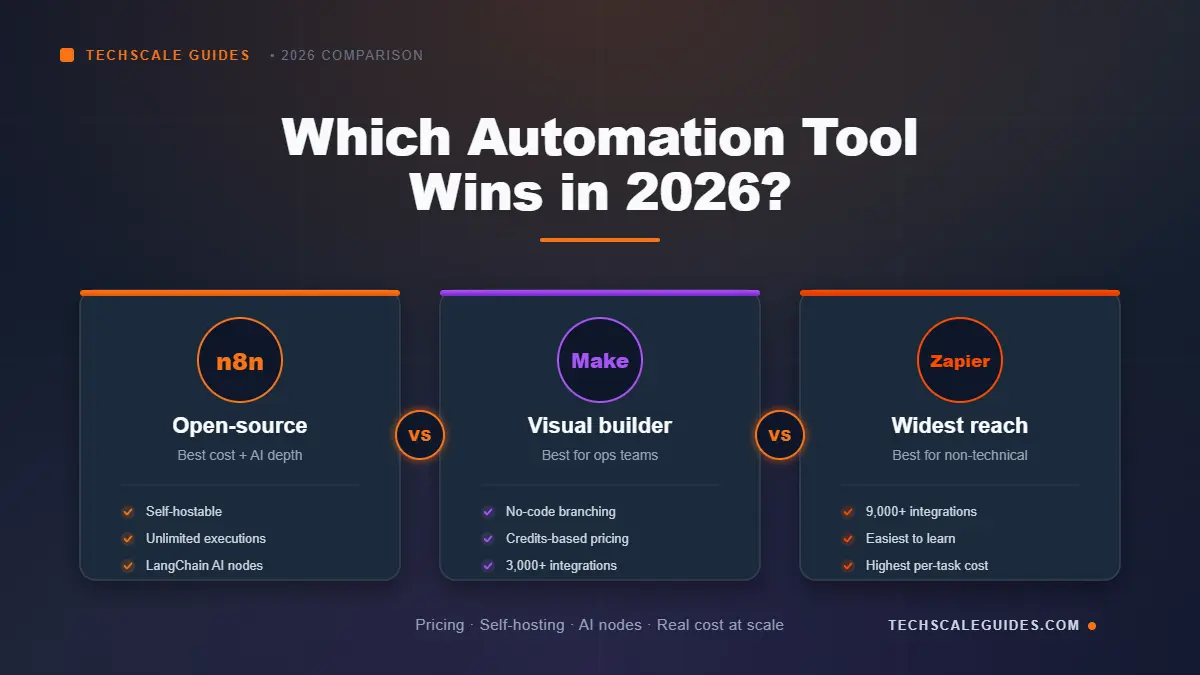
- n8n — Best for technical teams. Self-hostable, unlimited executions, deep AI/LLM control. Steeper learning curve.
- Make — Best for visual builders. Powerful branching, no code required. Credit-based pricing.
- Zapier — Best for non-technical users. Widest app coverage, highest per-task cost.
No tool wins universally. There's only the tool that fits your volume, skill, and budget.
If you're new to n8n, our full tutorial walks through the first workflow before comparing platforms.
Quick Comparison
| Factor | n8n | Make | Zapier |
|---|---|---|---|
| Entry price | €24/mo Cloud or free self-hosted | $9/mo (10K credits) | $19.99/mo (750 tasks) |
| Self-host | Yes | No | No |
| Pricing unit | Executions | Credits | Tasks |
| Complexity ceiling | Highest | High | Medium |
| Native AI/LLM | LangChain + AI Agent node | AI Agents + AI Toolkit | AI Actions + MCP |
| Integrations | 400+ native + any HTTP API | 3,000+ | 9,000+ |
| Best for | Dev teams | Ops teams | Non-technical users |
Entry prices shown reflect annual-billing rates for Make and Zapier, monthly-billing rate for n8n Cloud. n8n Cloud priced in EUR; Make and Zapier in USD. See detailed breakdown below.
Pricing — The Real Math
Pricing pages show entry tiers. Not cost at scale. Here's what you actually pay at 10,000 executions/month.
n8n
Cloud starts at €24/month for 2,500 executions (monthly billing) or €20/mo billed annually. Pro is €60/month for 10,000 executions (€50/mo billed annually). Business is €800/month for 40,000 executions (€667/mo billed annually). Prices in EUR — convert if billing in USD. Check n8n.io/pricing for current tiers.
Community Edition is free. Unlimited executions. You pay for the server — a $6–12/month VPS handles most SMB workloads.
As of September 2026, n8n is at version 2.39.6 (released 2026-09-16, 2.x stable line). The 1.x line reached end of support on March 15, 2026. Self-hosting needs Docker, a reverse proxy, and SSL.
Make
"Operations" was renamed to "credits" on August 27, 2025. Same concept, new name. Ignore older tutorials. Verify current pricing at make.com/en/pricing.
Free tier: 1,000 credits. Core: $9/month for 10,000 credits (billed annually; $10.59/month on monthly billing). Pro: $16/month for 10,000 credits (billed annually; $18.82/month on monthly billing) plus advanced features.
How AI billing actually works — this trips people up:
There are two ways to connect AI models in Make, and they bill differently.
- Custom AI provider connection (your own OpenAI/Anthropic API key): 1 credit per operation. Token costs go directly to your OpenAI/Anthropic account — Make doesn't touch them. A call to GPT-4o, GPT-5.2, or GPT-4.1 costs 1 Make credit, regardless of prompt length. Note: GPT-4o was retired from ChatGPT in February 2026, but the API model remains available for developers.
- Make's AI Provider (built-in, available on all plans): 1 credit per operation + token-based credits. Make bills you for tokens. As of August 25, 2026, Make calculates credits with separate rates for input and output tokens:
- Small/Medium models: 18,080 input tokens per credit / 2,260 output tokens per credit
- Large models: 3,616 input tokens per credit / 452 output tokens per credit
Check Make's docs for the specific model you're using before estimating cost.
If you're already paying OpenAI directly, use your own API key. You'll save on credit consumption. If you don't want to manage provider billing, Make's AI Provider is simpler — but costs more credits at high volume.
Zapier
Most expensive per action. Free: 100 tasks/month. Professional: $19.99/month for 750 tasks (billed annually; $29.99/month on monthly billing). Team: $69/month for 2,000 tasks (billed annually; $103.50/month on monthly billing). At 10,000 tasks/month you're roughly 5–8x n8n Cloud at the same volume. Check zapier.com/pricing for current tiers.
As of September 2025, Zapier Tables, Interfaces, and MCP are included in Free, Professional, and Team plans — not separate products anymore.
Cost at 10K executions/month:
| Platform | Monthly | Notes |
|---|---|---|
| n8n self-hosted | ~$6 | VPS + your time |
| n8n Cloud Pro | ~€60 (€50 annual) | Managed |
| Make Pro | ~$16 ($18.82 monthly) | AI billing depends on provider setup |
| Zapier Team | ~$69+ ($103.50 monthly) | 2K tasks |
Real-world scenario: a lead-response workflow firing 300 times/day = ~9,000 executions/month. On n8n Cloud Pro (€60): fixed. On Make Pro ($16 + AI operations): depends on whether you're using your own OpenAI key. On Zapier Team: roughly 2–3x the n8n cost. Same workflow, very different bill.
For a real production example of this workflow in n8n, see our HVAC lead-response case study.
Self-Hosting — n8n's Killer Feature
Only n8n self-hosts. Make and Zapier are cloud-only. For data residency, compliance, or tight budgets — this decides it.
Self-hosted n8n = unlimited executions for the cost of a VPS. No task ceiling. No vendor lock-in.
The catch: you own the ops. Docker updates, backups, SSL, monitoring, security patches. If a workflow fails at 3 AM, there's no support ticket.
Heads up for October 2026: n8n 3.0 will make Docker-based deployment mandatory for self-hosting. If you're still on npm/npx installs, plan the migration. Check docs.n8n.io for the full breaking-changes list. For the full self-hosting production setup guide — Docker Compose, queue mode, PostgreSQL, Cloudflare R2 — see our Part 4: n8n Production Deployment guide.
AI & LLM Nodes — Where n8n Pulls Ahead
n8n has native LangChain integration. The AI Agent node (root node in the LangChain category) builds multi-step reasoning workflows with tool calling, memory, and vector retrieval. Direct API access to OpenAI, Anthropic, Gemini.
Make has AI Agents and AI Toolkit. Visual agent building. Clean UI, less granular than n8n. AI credit cost depends on provider setup — your own API key costs 1 operation per call; Make's built-in AI Provider adds token-based credits with separate input/output rates.
Zapier has AI Actions and MCP. Simplest setup. Great for single-step tasks. Less suited for multi-agent orchestration.
n8n wins complex AI workflows. Make wins visual-first teams. Zapier wins when you need AI + 9,000 integrations in one place.
For the full architecture behind production AI agent workflows, see our AI agent architecture blueprint.
Complexity Ceiling
n8n — Highest. Code node runs JavaScript/Python. Sub-workflows modularize. Retry logic at workflow level.
Make — High, visual-first. Iterators, aggregators, routers, error handlers. Breakpoints for debugging. Complex scenarios get visually messy.
Zapier — Medium. Paths and Filters work. Loops and error handling feel bolted on. If you need nested logic or 10+ steps, it gets awkward.
Real talk: workflows over 15 steps with branching → n8n or Make saves hours.
Integrations — Breadth vs Depth
Zapier: 9,000+ apps (as of September 2026). Make: 3,000+. n8n: 400+ native.
But count is misleading. Zapier integrations are often shallow — basic triggers only. Make is deeper per app.
Custom API is not n8n-exclusive. All three platforms handle apps without native integrations:
- Make: HTTP app with OAuth 2.0 keychain support, raw JSON parsing, unstructured payload handling.
- Zapier: Webhooks by Zapier — Custom Request supports PATCH/DELETE, nested JSON, custom headers.
- n8n: HTTP Request node + Credential-only nodes + Predefined Credential Types (reuse existing auth without re-setup).
The real n8n advantage isn't the HTTP node. It's combining HTTP Request with the Code node (JavaScript/Python) in the same workflow — transform messy payloads, extract nested fields, build custom logic without hitting Zapier's step ceiling or Make's visual spaghetti. That combination is what makes n8n cheaper and cleaner for complex API work.
Working with webhooks? Part 2 of our n8n tutorial covers the webhook node in depth.
Migration & Lock-In
Switching platforms is not free. Plan for it.
n8n 1.x → 2.x — if you're still on the old line, upgrade now. 1.x support ended March 2026. Breaking changes include task runners enabled by default and workflow execution model changes.
Zapier → n8n — easiest migration path. Export Zap steps, rebuild in n8n. From my experience: simple linear Zaps take under an hour. Complex multi-step workflows take a full weekend.
Make → n8n — harder. Make's visual iterators and aggregators don't map 1:1 to n8n nodes. Expect several hours per complex scenario.
n8n → anywhere else — hardest. You're leaving unlimited executions for a task ceiling. Rarely worth it unless you're abandoning self-hosting entirely.
Lock-in reality: Zapier and Make own your workflows. Export is possible but partial — Zapier exports JSON, Make exports a blueprint, but neither is 1:1 portable. n8n self-hosted = you own the data, the config, the backups. This alone is why technical teams standardize on n8n.
Which One Should You Pick?
n8n if: technical team, want self-hosting, AI-heavy workflows, comfortable with Docker.
Make if: visual building without code, complex branching needed, cloud-only is fine.
Zapier if: non-technical, need niche SaaS integrations, linear low-volume workflows.
Real pattern I see: technical teams end up on n8n. Ops teams on Make. Non-technical founders start on Zapier and migrate when costs hit $100+/month.
The Hidden Cost of DIY
Self-hosted n8n sounds free. It isn't.
You pay with time. Docker setup, SSL, backups, monitoring, patches. 4–8 hours upfront, 1–2 hours/month ongoing. At $50/hour, that's $250–600 in year one — before you've built a workflow.
Zapier and Make cost less upfront. But costs scale linearly. At 50,000 tasks/month, Zapier hits $500+.
Pay with money or pay with time. Pick based on which is scarcer.
If you know what you need built but don't want to spend weeks learning n8n's node system, hire a specialist on Upwork. Production n8n workflows with error handling and docs run $300–800. Cheaper than three weeks of your own time at most rates.
Frequently Asked Questions
1. Is n8n really free?
Self-hosted Community Edition: yes, unlimited. You pay for the server ($6–12/mo VPS). n8n Cloud is paid, from €24/month monthly billing (€20/mo billed annually).
2. Can I migrate from Zapier to n8n?
Yes, but no one-click converter. From experience: simple linear Zaps take under an hour. Complex multi-step: a weekend.
3. Cheapest at 50K executions/month?
Self-hosted n8n (~$12/mo VPS). Make: ~$100–200/mo. Zapier: $500+.
4. Does Make still use "operations"?
No. Renamed to "credits" August 27, 2025. Older tutorials use the old term.
5. Does Make charge extra credits for AI tokens?
Depends on how you connect the AI. If you bring your own OpenAI/Anthropic API key, Make charges 1 credit per operation — token costs go straight to your provider. If you use Make's built-in AI Provider, Make bills you for tokens. As of August 2026: Small/Medium models = 18,080 input tokens or 2,260 output tokens per credit. Large models = 3,616 input tokens or 452 output tokens per credit.
6. Which is best for AI agent workflows?
n8n. Native LangChain nodes, sub-workflow modularity, and self-hosted execution keeps AI token billing direct from the model provider. And since n8n connects directly to the OpenAI API, you can still use GPT-4o via API even though ChatGPT no longer offers it.
7. Can I run n8n without Docker?
Yes — n8n Cloud, or npm install for local dev. For production self-hosting, Docker is the standard path. Alternatives: PM2, Kubernetes. Docker is easiest.
8. What's coming in n8n 3.0?
Docker-only self-hosted deployment (npm/npx dropped). Legacy nodes removed: Function, Function Item, Item Lists. AI Agent v1 removed — only Tools Agent remains. Ships October 2026.
Bottom Line
- n8n wins cost, AI depth, self-hosting — if you're technical. Note: 2.x is current; 1.x is end-of-life.
- Make wins visual complexity for ops teams — no code. AI billing is flexible if you bring your own API key.
- Zapier wins breadth and ease — at highest per-task cost.
Pick based on what your team can maintain six months from now, not feature checklists.
Want to shortcut setup? Hire someone who's already built 50+ workflows on your platform. Better ROI than a month of trial-and-error.